

Hormone replacement therapy stigma finally removed
Now begins the reeducation and reconditioning of our fearful doctors

11/13/25
In the early 2000s, the FDA put an inappropriate “black box” warning on hormone replacement therapy (HRT) products for female patients in the various stages of menopause.
They claimed these hormones could cause a range of deadly illnesses, including cancer and heart disease.
As a result, millions of women (and those around them) suffered needlessly.

“This is, in my opinion, one of the greatest mistakes in modern medicine -- the demonization of hormone replacement therapy.”
-FDA Commissioner Dr. Marty Makary
On November 10, 2025, the FDA decided to finally correct that 20-year-old bad call, and will remove that warning.

The challenge now will be to make our doctors aware of this long-overdue correction, and to overcome their fears (and the fears of their bosses).
Fully-informed doctors
Instead of discouraging the use of HRT, the FDA now recommends fully-informed, shared decision-making between the patient and her doctor regarding HRT.
To do that, doctors need to be fully informed.
First, they need to understand why the study that scared them away from HRT for more than 20 years was misleading and completely irrelevant to women taking bioidentical and transdermal hormones.
Second, they need to understand why women need those hormones ... not just for a decade or so, but for life.
There may be no other medication in the modern era that can improve the health outcomes of women, on a population level, than hormone replacement therapy.
-FDA Commissioner Dr. Marty Makary
And they need to know how to use them properly and safely, which includes:
Understanding the risks of not balancing hormones that keep one another in check.
Being aware of the different categories of HRT and the risks and benefits of each.
So that’s the big news. But how did we get here?
How HRT went from miracle to curse virtually overnight
There once was a time when menopausal women were freely given HRT when their bodies went through “the change” called menopause.
It was known far and wide that families and coworkers praised whatever gods that gave the menopausal women in their circles calmer moods, cooler thermostats, and more restful sleep.
In fact, by 2002, approximately 12 to 16 million women in America were taking HRT.
And nearly all of them used an estrogen product called Premarin, with or without its progesterone-like product, Provera. The combo product was called Prempro.
But in July of 2002, the Women’s Health Initiative (WHI) study results were published.
And that sent the field of gynecology into a major tailspin.
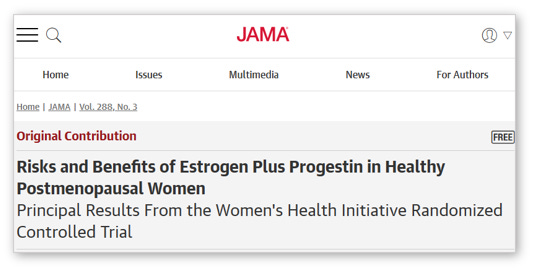
The Women’s Health Initiative
The WHI was designed to study the effects of Prempro in some 16,000 women with an intact uterus.
It was set to run for seven years, but was stopped early at 5.2 years because the researchers were seeing increases in serious conditions.
The results were then presented to the medical community in misleading ways that made them seem more significant (and scarier) than they actually were.
Although the percentage of change seemed impressive, in most cases, the total risk increase or decrease of the given condition was very small.
Think of it this way: If you say your savings increased by 50%, it sounds like a lot, until you reveal that you had only had a dime saved to begin with, and only gained a nickel. The total amount of money in your savings is still very small.
That’s the scale of increased/decreased risk we’re looking at here from the WHI.
Heart disease risk UP 23% (total risk less than 0.005%)
Breast cancer risk UP 27% (total risk less than 0.005%)
Stroke risk UP 38% (total risk less than 0.004%)
Blood clot risk UP 112% (total risk 0.005%)
Endometrial (uterine) cancer: no difference
Osteoporosis risk DOWN 33% (total risk less than 0.1%)
Colorectal cancer DOWN 33% (total risk 0.1%)
Deaths overall: No difference between Prempro and placebo groups
Still, the results LOOKED or FELT scary.
So doctors everywhere stopped prescribing HRT of all kinds. And when they did prescribe it, they were warned, by their superiors all the way up to the HHS, to use the smallest amount for the shortest period of time.
Imagine your mechanic saying that if your older car runs low on oil, only add a cup, or a tablespoon of oil at a time, and only until you can taper it off oil entirely.
Sounds dumb when you say it that way.
What they don’t tell you about the WHI
Among the key problems with the WHI are these:
Only one HRT product (Prempro) was studied. So the WHI can’t tell us anything about the effects of other HRT products, even though all HRT formulations were stigmatized equally.
Premarin is horse estrogen (conjugated equine estrogen/CEE). It’s made from the urine of pregnant mares kept in captivity. Human women have no natural enzymes that can break down horse estrogen after its work is done in a given cell. Therefore, the CEE molecules attached to human cells keep turning on the cell’s effects far longer than the natural or bioidentical (chemically identical to nature’s) hormone molecules would.
The Provera in Prempro may have been the primary offender. Although the study with Prempro was stopped early, another study that used only Premarin (horse estrogen) was allowed to continue. This suggests that the fake progesterone in the combo product was responsible for the problems that led to the early termination of the study. Provera is a synthetic form of progesterone that may or may not offer the modulating/balancing effects on estrogen that natural or bioidentical progesterone has.
The study was too short to prove Prempro causes breast cancer. The study only ran for 5.2 years, and it takes roughly 7-10 years for a single cancer cell to become a detectable tumor. Therefore, all the WHI could prove was that horse estrogen and fake progesterone together might accelerate the growth of existing breast cancer tumors that some subjects already had when they entered the study.
Prempro and Premarin are pills, and pills have to go though the gut and the liver first, breaking down the hormones before anything reaches the woman’s cells.
The study’s authors noted that other types of HRT could yield different results. Bioidenticals might be more beneficial than the bio-deviant hormones the WHI studied. Likewise, injected or transdermal (through the skin, like creams, gels, and patches) hormones might have more beneficial effects because they go directly into the bloodstream like natural hormones, avoiding that “first-pass” through the liver that breaks down oral hormones before they reach the organs and cells.
“The results do not necessarily apply to lower dosages of these drugs, to other formulations of oral estrogens and progestins, or to estrogens and progestins administered through the transdermal route. It remains possible that transdermal estradiol (E2 estrogen) with progesterone, which more closely mimics the normal physiology and metabolism of endogenous sex hormones may provide a different risk-benefit profile.”
-From the “Limitations” section of the JAMA paper
Why do women need these hormones?
Some women do just fine during and after menopause with no special treatments.
Others take pride in letting nature take its course, no matter how disturbing the symptoms may be.
This parallels the “It’s normal to lose your hormones with age, so don’t fight it” approach among many doctors.
To me, it’s the equivalent of saying, “It’s natural for your car to run out of oil, so don’t replace it.”
But consider this: If your thyroid hormones run low, your doctor gives you replacement thyroid hormones. Right?
Why not sex hormones?
This is not rocket surgery.
We tend to think of these hormones as primarily necessary for making babies.
But the fact is that our bodies are designed to run on these hormones for processes that go way beyond basic reproduction.

Let’s consider some of the benefits.
Estrogen: estrone (E1), estradiol (E2), and estriol (E3)
Used by some 300 systems in the body, including nervous system and brain, bones, liver, and urinary tract
Promotes cell division and blood clotting
Promotes healthy bone remodeling
Modulates thyroid activity
Calms moods
Facilitates sound sleep
Supports cognitive function
Has antioxidant and anti-inflammatory effects
Suppresses production of stress hormones
Keeps skin and tissues soft and supple
Progesterone
Offsets the cell-division and blood-clotting effects of estrogen
Protects cell membranes
Increases good cholesterol
Decreases fluid retention
Reduces mood swings and depression
Promotes cognitive function
Helps build healthy bone and muscle
Supports thyroid function
Supports sound sleep
Helps normalize blood sugar
Protects against uterine fibroids, fibrocystic breasts, and endometrial/uterine cancer
Breaks down into testosterone
Testosterone (Yes, women need it too, though only about 10% of male levels)
“Anabolic” hormone that builds bone and muscle
Supports healthy sex drive
Promotes creativity, ambition, self-confidence
Supports memory, cognitive function, helps prevent dementia
Reduces body fat and increases energy
Offsets risks of cardiovascular conditions that may be promoted by estrogen
Double standard
Curiously, we’ve never seen a comparable study or prohibition on HRT when it comes to giving men supplemental testosterone.
For that matter, the medical community has been pretty generous with estrogen and testosterone products for transgender females and males as well.
I guess it’s only natural females who needed to be “protected” from hormone products that can keep their bodies operating at peak performance well into old age.
And I guess only natural females are at risk for the conditions associated with hormone therapy.
Journey from the black box to health freedom
So they remove the black box warning on estrogen and progesterone products for menopausal women. Then what?
Now, we need to either educate the doctors we have or find doctors who are aware of the news.
But old habits are hard to break.
I struggled for years to find doctors who would prescribe the estradiol patch and compounded hormone creams I had been using successfully since my hysterectomy in 2005.
HRT was the only thing that let me sleep through the night, work with a clear head, imagine story worlds for my books, remember common words, stop feeling like ants were crawling on my skin, and not have songs playing in my head 24/7 for an entire year.
HRT literally saved my life. And it saved who I am.
Women seeking to stay on or get back on HRT may have to shop around for awake doctors who are not afraid to prescribe hormones, especially to older women.
The crazy thing is that most doctors will gladly prescribe boatloads of harmful drugs that poorly address the symptoms of low or imbalanced hormones, but they won’t just supplement and balance the dadgum hormones.
For example, they’ll offer drugs that preserve old, brittle bone instead of just prescribing estrogen and progesterone that, together, promote the normal remodeling that breaks down old bone and rebuilds resilient new bone.
For hot flashes, they’ll prescribe antidepressants, anti-seizure or anticonvulsant medications, or drugs for high blood pressure or overactive bladder.
But they won’t just prescribe estradiol (E2) which naturally restores a woman’s normal temperature regulation mechanisms, and which breaks down into the most benign and protective form of estrogen, estriol (E3), which can promote restful sleep.
Next steps
The solution isn’t perfect. The FDA still discourages the use of HRT for women over 60.
Why?
Doctors don’t stop giving thyroid hormones to people with low thyroid when they turn 60.
So, why stop sex hormones? Do women stop needing strong bones? Do they stop needing to sleep soundly? Do they stop needing to think, remember, or be creative after 60?
Honestly, I suspect many doctors put HRT for older women in the same category as cosmetic surgery. They think it’s purely about vanity.
Oh, but hormones for older men and trans people is necessary for their health and mental wellbeing. Go figure.
What women can do is print out news articles showing the FDA’s decision to remove the black box warning, and give copies of the clippings to our doctors.
Maybe even provide a copy of this article along with its references.
Unfortunately, doctors who are afraid to rock the boat with their superiors (at joint practices, healthcare and insurance groups, hospitals, and even the government) will not be moved.
We just have to hope there are enough enlightened and unafraid physicians and nurse practitioners out there to help us maintain optimal conditions in our bodies.
For life.

RESOURCES
“Hormone replacement therapy will no longer carry a warning label. FDA says”
“FDA Removes Black Box Warning on Hormone Therapy”
https://time.com/7332940/fda-estrogen-menopause-black-box-warning/